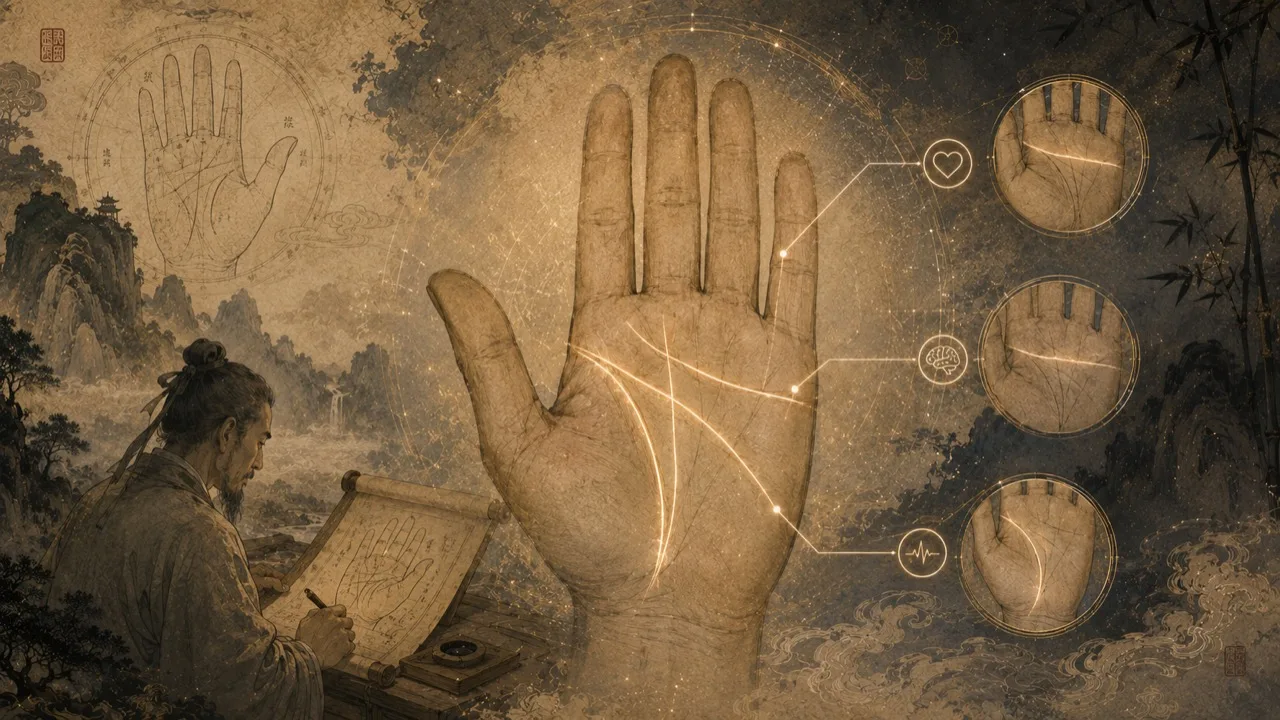
Introduction to Palm Reading: What Your Hand Reveals
A beginner's guide to palmistry — learn how the shape of your hand, the major lines, and the mounts reveal personality traits, talents, and life patterns.
Palm reading — known as palmistry or chiromancy — is one of the world's oldest and most widespread forms of divination. Found across Chinese, Indian (Jyotisha), and Western traditions, it interprets the lines, mounts, and shape of the hand to reveal personality, potential, and patterns in a person's life.
Which Hand Do You Read?
A foundational question in palmistry: left or right?
- The non-dominant hand (usually the left for right-handers) shows your innate potential — what you were born with, your natural disposition and inherited traits.
- The dominant hand (usually the right) shows how you've shaped your life — choices made, habits formed, and the current trajectory.
Reading both hands together reveals the gap between your potential and what you've actually developed.
In Chinese palm reading tradition, the left hand is read for men under 30 and women over 30; the right for men over 30 and women under 30 — based on the concept of yin-yang energy flow.
The Shape of the Hand
Before looking at lines, the hand's overall shape gives a foundational reading:
| Hand Type | Shape | Personality |
|---|---|---|
| Earth hand | Square palm, short fingers | Practical, grounded, reliable |
| Air hand | Square palm, long fingers | Intellectual, communicative, analytical |
| Water hand | Rectangular palm, long fingers | Intuitive, emotional, creative |
| Fire hand | Rectangular palm, short fingers | Energetic, passionate, impulsive |
The Three Major Lines
1. The Life Line
Curving around the base of the thumb, the life line does not predict how long you'll live. Instead it reveals:
- Vitality and physical energy
- Major life transitions (where the line breaks or changes direction)
- Quality of life, not quantity
A long, deep, clear line suggests strong constitution and a stable life path. A shorter or faint line may indicate someone who relies on mental energy more than physical stamina.
2. The Heart Line
Running horizontally across the upper palm, the heart line covers:
- Emotional style — how you love and relate to others
- Relationship patterns
- Cardiovascular health indicators
A long heart line extending to the index finger suggests idealistic romanticism. One ending beneath the middle finger indicates a more practical, self-directed approach to love.
3. The Head Line
The middle horizontal line represents:
- Thinking style — logical vs. intuitive
- Intellectual interests and potential
- Decision-making patterns
A straight head line indicates analytical, linear thinking. A curving line that slopes toward the wrist suggests imagination and creativity.
The Mounts
The fleshy pads on the palm, called mounts, correspond to planetary energies in Western palmistry and to organ systems in Chinese tradition:
- Mount of Jupiter (below index finger) — ambition, leadership
- Mount of Saturn (below middle finger) — discipline, responsibility
- Mount of Apollo (below ring finger) — creativity, success, happiness
- Mount of Mercury (below little finger) — communication, business acumen
A well-developed mount (firm and raised) amplifies the qualities it represents. A flat mount suggests those qualities are less prominent.
What Palm Reading Can and Can't Tell You
Palmistry is best understood as a map of tendencies, not a fixed prediction. Lines on the palm actually change over time — research has documented this — reflecting how your life choices and experiences shape you.
Think of your palm as a living document of who you are and where you're going. It's one of many tools for self-reflection.
See your palm reading with AI: Analyze your palm now →
More Posts
Life Line, Heart Line, Head Line — The Three Major Palm Lines Explained
Understand what the three main lines on your palm really mean. A clear guide to reading the life line, heart line, and head line in palmistry.

How to Read Facial Features: Eyes, Nose, Mouth & More
A practical guide to interpreting the five major facial features — what your eyes, nose, mouth, ears, and forehead reveal about personality and fortune.
What Is Face Reading? A Beginner's Guide to Physiognomy
Discover the ancient art of face reading — how the shape of your forehead, eyes, nose, and mouth can reveal your personality and life path.
Newsletter
Join the community
Subscribe to our newsletter for the latest news and updates