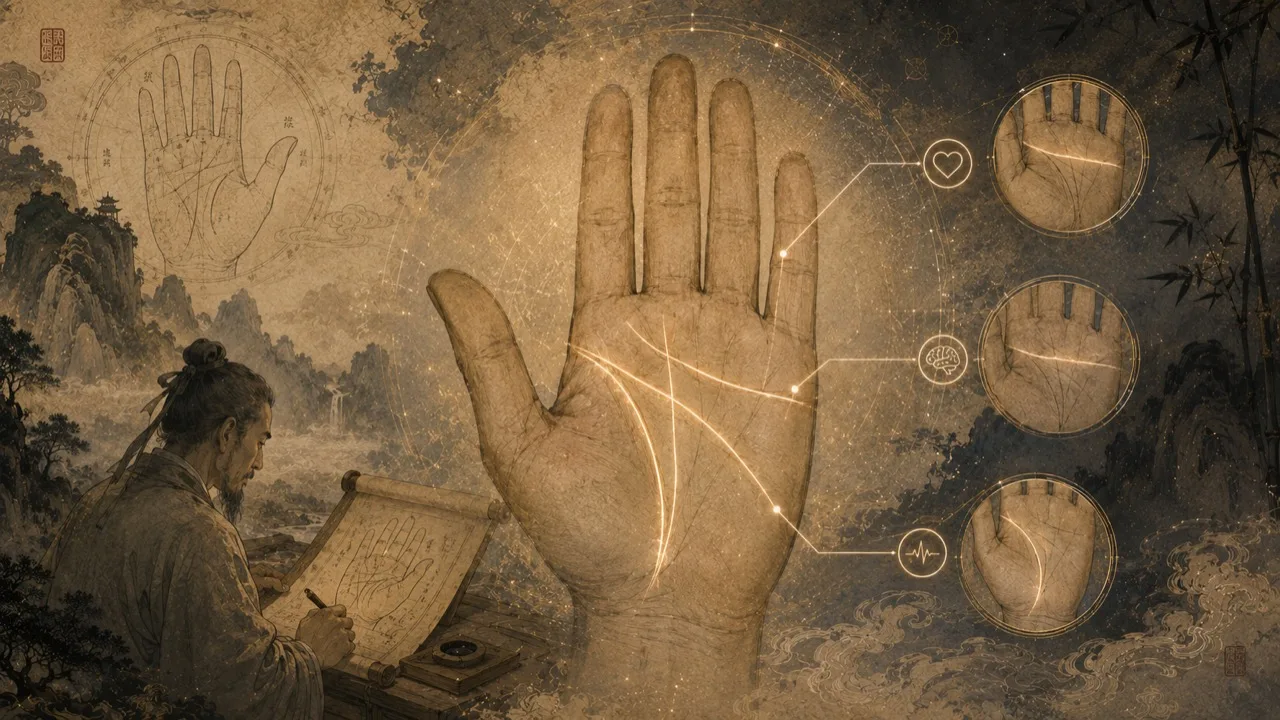
Life Line, Heart Line, Head Line — The Three Major Palm Lines Explained
Understand what the three main lines on your palm really mean. A clear guide to reading the life line, heart line, and head line in palmistry.
The three major lines of the palm are the starting point for any palm reading. They are present on nearly every hand, and together they form the core narrative of a person's constitution, emotional life, and mental character. Here's how to read each one in depth.
1. The Life Line — Vitality, Not Longevity
Location: Curves around the base of the thumb, arcing downward toward the wrist.
The most misunderstood line in palmistry. People fear a short life line — but length is only one factor. Focus on:
Quality indicators
- Deep and clear: Strong life force, good health, consistent energy levels
- Faint or thin: More sensitive constitution; energy may be variable
- Broken: A major life change or disruption at the corresponding age point
- Chained (looks like a chain of links): Periods of scattered energy, health fluctuations
- Double life line: An especially protective inner line called the "Mars line" — a sign of resilience and recovery
Length and arc
- A wide arc sweeping toward the center of the palm suggests an outgoing, adventurous personality
- A narrow arc staying close to the thumb indicates a more cautious, home-centered nature
Reading age on the life line
Age is mapped along the line from top (youth) to bottom (old age). A break at the midpoint suggests a significant change around midlife.
2. The Heart Line — Love, Emotion, and Relationships
Location: Runs horizontally across the top of the palm, below the fingers.
The heart line reveals emotional style — how a person loves, what they need in relationships, and how they process feelings.
Where it ends tells the story
| Ending position | Interpretation |
|---|---|
| Under the index finger | Idealistic love; high standards; sometimes disappointment |
| Between index and middle finger | Balanced approach; practical yet romantic |
| Under the middle finger | Self-focused in love; practical, may prioritize stability over passion |
| Straight across | Controlled emotions; may suppress feelings |
| Curves upward at end | Warm, expressive, demonstrative affection |
Other indicators
- Long and deep: Intense emotional life, strong attachment style
- Short: Less emotionally driven; prefers independence
- Forked at the end: Versatile in relationships; can see multiple perspectives
- Chained: Complicated or inconsistent love experiences
3. The Head Line — Thinking Style and Mental Strengths
Location: Starts near the beginning of the life line and runs horizontally across the middle of the palm.
The head line is about how you think, not how smart you are. It reveals cognitive style, learning preferences, and decision-making tendencies.
Direction of the line
- Straight across: Linear, logical thinker. Prefers facts and structure. Excels at analysis.
- Slightly curved: Balanced between logic and intuition. Adaptable.
- Deeply curved toward wrist: Highly imaginative, creative, intuitive. May overthink. Well-suited to artistic or philosophical work.
Length of the line
- Long: Wide-ranging intellectual curiosity; thinks through issues thoroughly
- Short: Focused and decisive; prefers practical over abstract
Connection to the life line at the start
- Lines joined for a long stretch: Cautious, family-oriented, risk-averse in youth
- Lines joined briefly: Normal balance of caution and independence
- Lines separate from the start: Highly independent thinker; confident, sometimes impulsive
Reading the Lines Together
No line tells the full story alone. Consider this example:
A person with a short life line (cautious energy), a deep heart line ending under the index finger (idealistic in love), and a curved head line (creative) suggests someone who is selective about commitments, deeply romantic when they do love, and most fulfilled in imaginative work.
This kind of synthesis — reading the lines as a conversation — is what separates surface-level palmistry from genuine insight.
Get an instant AI reading of your palm lines: Analyze your palm now →
Author

Categories
More Posts

The History of Chinese Physiognomy — 3,000 Years of Reading Faces and Hands
Explore the rich history of Chinese physiognomy (相学), from its origins in the Zhou Dynasty to its modern revival through AI-powered face and palm reading.
Introduction to Palm Reading: What Your Hand Reveals
A beginner's guide to palmistry — learn how the shape of your hand, the major lines, and the mounts reveal personality traits, talents, and life patterns.
What Is Face Reading? A Beginner's Guide to Physiognomy
Discover the ancient art of face reading — how the shape of your forehead, eyes, nose, and mouth can reveal your personality and life path.
Newsletter
Join the community
Subscribe to our newsletter for the latest news and updates